

Coffee equipment
Coffee & Chocolate

249 NOK
In stock
🚚 Daily Shipping from Sarpsborg, Norway🕛 Orders before 11:00 ship same day
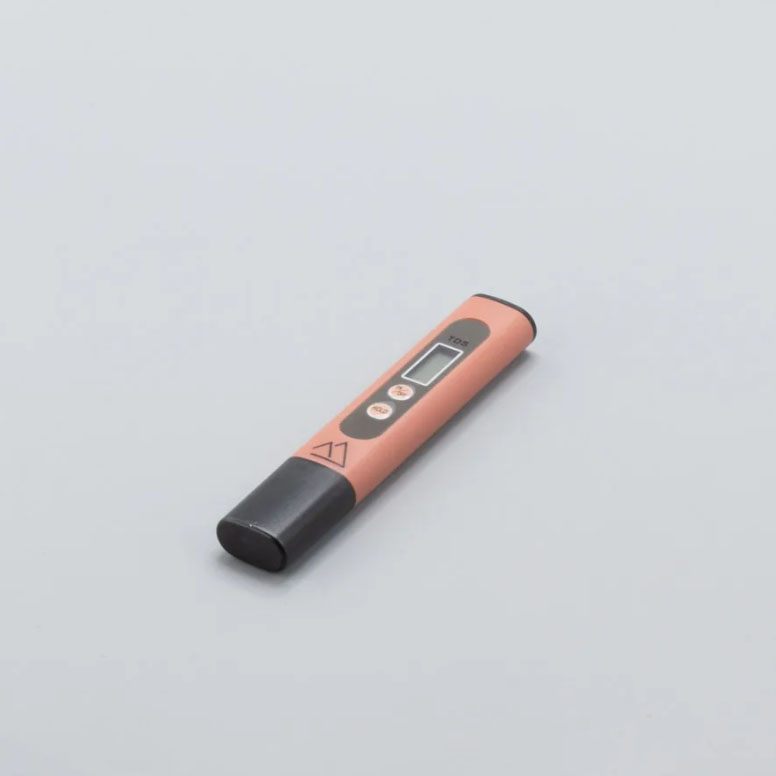
A pen-style digital TDS meter for checking the total dissolved solids in your brew water. It measures electrical conductivity and converts that to a ppm reading, which tells you how much mineral content is in the water in front of you.
Useful in two places: confirming your base water is close to zero before you build a recipe, and verifying that the recipe you mixed came out where you intended.
 Daily shipping from Sarpsborg
 Free shipping for KaffeBox subscribers
 Questions? We are here to help
A TDS meter passes a small current between two electrodes and measures how easily the water conducts it. Dissolved minerals carry charge, so more minerals means higher conductivity, and the meter converts that into a parts per million figure.
The important consequence is that it tells you how much is dissolved, not what. It cannot distinguish calcium from sodium, or hardness from alkalinity. Two waters reading 80 ppm can taste completely different in coffee if one is mostly bicarbonate and the other mostly magnesium. This is a quantity check, not a composition analysis.
If you build brew water from mineral concentrates, the meter answers the two questions that actually cause problems. First, is my base water really at zero? Filtered or distilled water drifts as a filter approaches the end of its life, and a base sitting at 15 ppm instead of 000 quietly shifts every recipe you mix on top of it. Second, did I dose what I think I dosed? A recipe targeting a known ppm gives you a number to check against, so a mis-measured dose shows up before you brew rather than after.
It is also the simplest way to find out what your tap water is doing, which is worth knowing even if you have no intention of building water from scratch.
This is a common mix-up worth being clear about. A TDS meter measures dissolved solids in water, before brewing. A refractometer measures dissolved coffee solids in a finished brew, which is what you use to calculate extraction yield. They sound similar and do entirely different jobs. If you are trying to work out your extraction percentage, this is not the tool.
Coffee’s dissolved solids are mostly uncharged. What’s actually in the cup is largely melanoidins, polysaccharides, caffeine, lipids and other organic compounds, none of which carry a charge in solution. They contribute essentially nothing to conductivity. The parts of coffee that do conduct are the mineral ions, potassium above all, plus the partially dissociated organic acids like chlorogenic and citric. That’s a real but small and variable fraction of the total. So the meter is blind to most of the mass it’s supposed to be measuring, and the ratio between the ionic fraction and the total shifts with roast level, origin, processing and brew method. There’s no stable conversion to fall back on.
Measure at room temperature. These meters are calibrated for water around 21 °C, and readings drift high in hot water and low in cold, so testing a kettle that has just boiled will not give you a usable number. Let the sample settle to room temperature first. The cap doubles as a small sample cup if you would rather not dip the probe into your main container.
One other thing to know: converting conductivity into ppm requires a conversion factor, and manufacturers do not all use the same one. Two different meters can therefore give slightly different readings on the same water. This does not matter for tracking your own consistency, since you are comparing against yourself, but it does mean a reading from this meter and one from another brand are not always directly comparable.
| Type | Digital pen-style TDS meter, conductivity based |
|---|---|
| Low range | 0 to 999 ppm, 1 ppm resolution |
| High range | 1,000 to 9,990 ppm, 10 ppm resolution |
| Range selection | Automatic |
| Controls | Single button |
| Hold function | Yes, freezes the reading on screen |
| Auto shut-off | 10 minutes of inactivity |
| Battery | LR44 |
| Calibration temperature | Approx. 21 °C |
Rinse and dry the probe after use, particularly if you have measured mineral-heavy water, and store it with the cap on. Do not submerge the meter past the probe section.
| Brand |
|---|
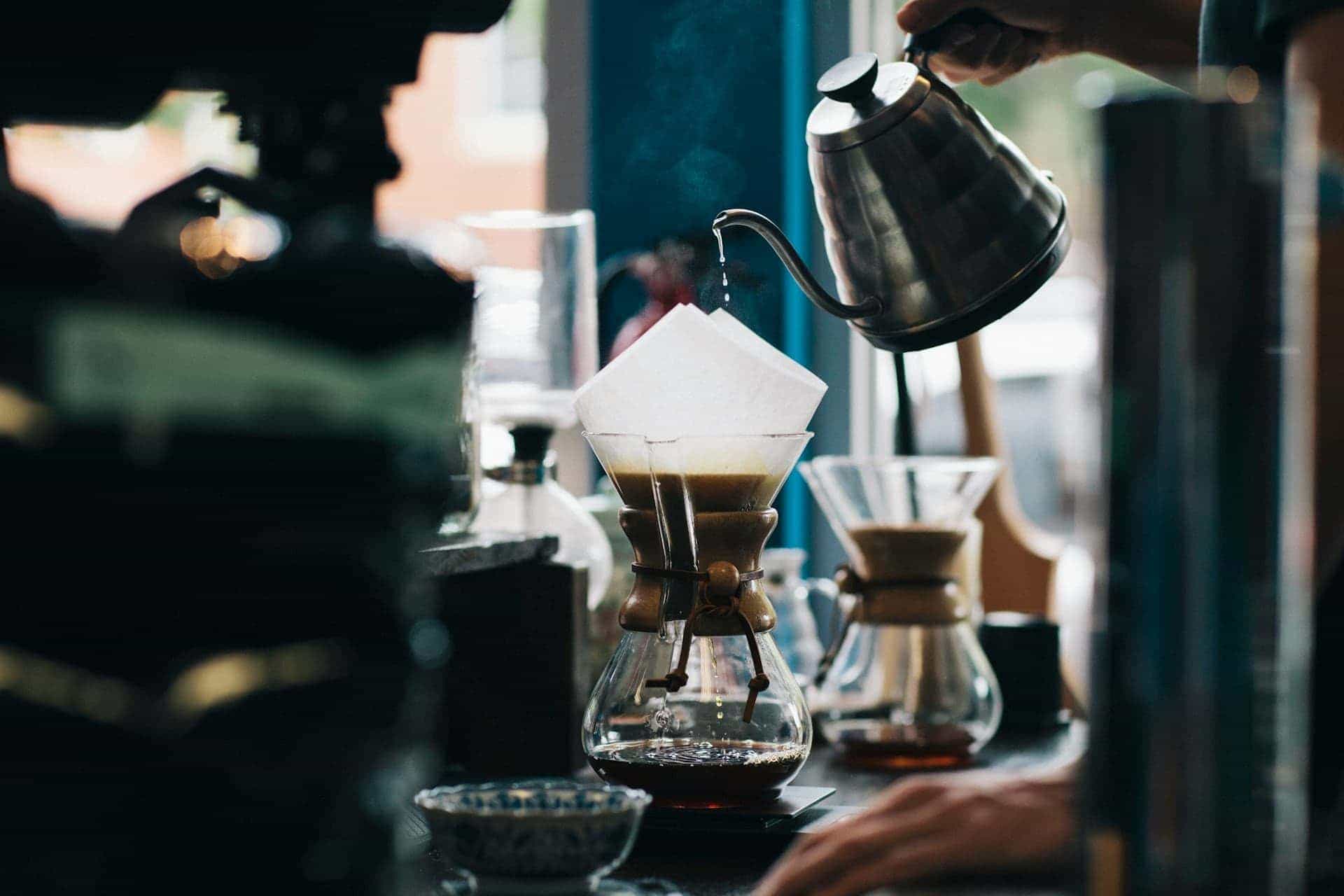
Just like how we carefully select coffee for our KaffeBox subscription, we choose the equipment for the Brewshop with the same commitment to quality. Our selections are designed to bring you satisfaction and durability, ensuring you can enjoy them for many years.
 Flair Cafe Kettle
Reviews
There are no reviews yet.