

Coffee equipment
Coffee & Chocolate

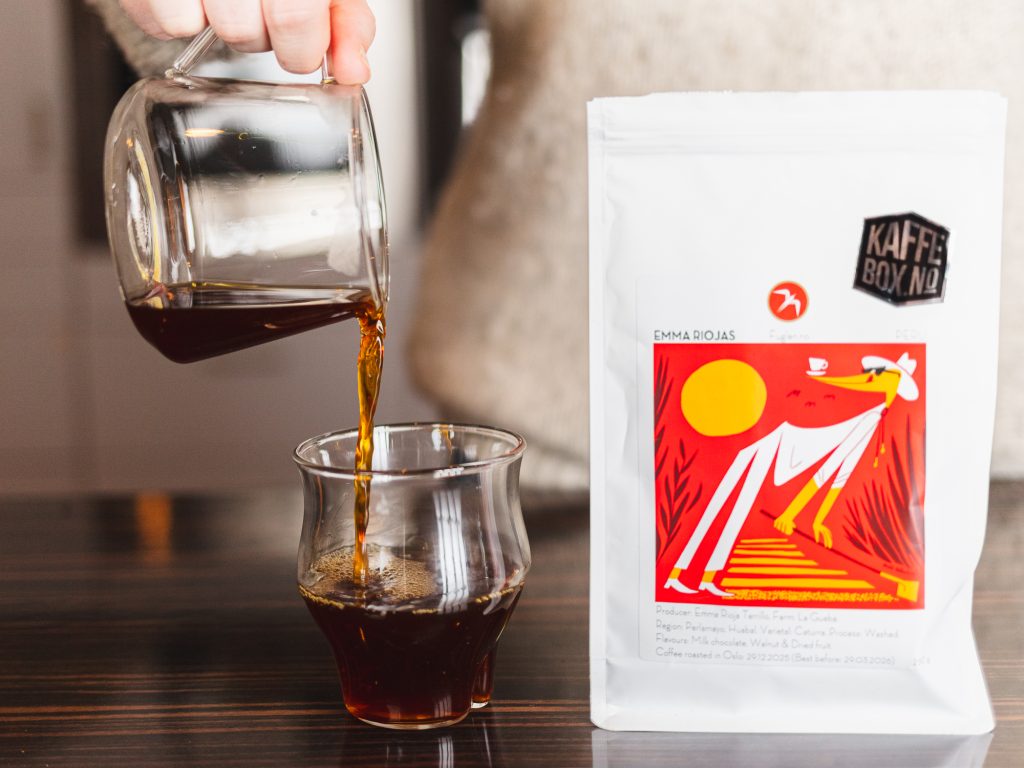

Milk chocolate, Walnut & Dried fruit
Origin: Peru
Producer: Emma Rioja Tarrillo
Region: Perlamayo, Huabal
Varieties: Caturra
Process: Washed
Altitude: 1877 m.a.s.l
The Rioja family runs a coffee farm called La Guaba located in Perlamayo, Peru at an altitude of 1877masl. The farm has been in the Rioja family for generations and is currently run by Emma Rioja Tarrillo.
The Riojas grow several coffee varieties on their 1ha farm including caturra, nacional and costa rica. This harvest yielded about 4000 kg of green coffee with the help of 5 employees.
The Riojas use traditional cultivation methods on their farm. They do manual and mechanical weeding and pruning to rejuvenate the plants. No chemical fertilisers are used.
For processing, Emma harvests only the ripest cherries by hand. The cherries are left to rest in black sacks under shade for 24 hours before pulping. After pulping, the beans are left to ferment in a tank for around 12 hours. The beans are then washed three times. Next they are dried outdoors on a tarp for a day before being moved to patios to finish drying over approximately 15 days. Emma turns the beans 6 times a day during patio drying.
After drying, the green coffee is stored in black polyethylene sacks at the farm for 15 to 20 days before being exported.
The Riojas face challenges from climate change and pests/diseases threatening production. But they remain dedicated to sustainably producing high quality specialty coffee at their family farm.

Cape gooseberry, Dark chocolate & Kiwi
Origin: Honduras
Producer: Benjamin Paz
Farm: La Leona
Region: Santa Barbara
Varieties: Pacas
Process: Washed
Benjamin Paz is an important figure in the coffee industry within Honduras. He comes from a family of coffee producers and owns his own farms as well as working at San Vicente which is a family-owned dry mill and export company.
Benjamin and San Vicente have done a lot for the coffee producers in their region, including contributing to the fame of Santa Barbara as a coffee region, and all this is shown by the number of finalists that place in the prestigious Cup of Excellence competition. Usually more than half of the finalists are from this beautiful region.
Benjamin decided to also get his own farm in 2015 and has been producing coffee there since. The farm is 3,5 hectares large, and Benjamin has planted Pacas, Bourbon, Caturra, Catuai, Parainema, and Geisha varieties. We buy this coffee directly from Benjamin and are happy to be able to work with such a great producer.
Flavour Profile: Prune, Pomegranate, & Gooseberry
Origin: Colombia
Producer: Neider Criollo Betancourt
Farm: La Virginia
Region: Tarqui
Municipality/County: Huila
Varieties: Colombia
Process: Washed
Altitude: 1700 masl
Neider Criollo Betancourt owns a 2.5-hectare farm called La Virginia, where he grows both Castillo and Colombia varieties. He’s been a farmer since 2012 and became a member of the cooperative Asociación Los Naranjos in October of 2020.
The association has just over 50 members, all smallholder farmers in and around the area of San Agustín, Huila. He was born into a coffee-growing family but his father passed away when he was only 8 years old. It wasn’t until 2012, when Neider traded a motorcycle for his first piece of farmland, that he got involved in the coffee-growing business. While at first he was limited in his ability to create high-quality coffee because of a lack of equipment, he has just begun realizing his dream of focusing on specialty coffee: His first-ever specialty delivery in 2020 cupped out at 87 points in the lab!
On Neider’s farm, the coffee is picked ripe and “rested” overnight in its cherries, for about 12 hours. It’s depulped the following day and fermented for 48–72 hours before being washed. In order to check if the coffee is ready for washing after fermentation, Neider feels it with his hands to gauge the temperature: He has developed his process of recognition through trial and error after a full year of experimentation. The coffee dries for 15–30 days in a solar dryer.
We buy this coffee direct with the help of Fairfield Trading.

Orange, Vanilla & Dark chocolate
Origin: Ethiopia
Producer: Smallholder producers
Station Name: Bensa Logita
Region: Bensa, Sidamo
Varieties: Heirloom
Process: Natural
Altitude: 1200 – 2100 m.a.s.l

Grapefruit, Raisin & Chocolate
Origin: Colombia
Producer: Gilma Rosa Gutierrez
Coffee Region: Planadas, Tolima
Farm: La Esperanza
Varieties: Colombia & Castillo
Process: Washed
Altitude: 1600 m.a.s.l.
Introducing Gilma Rosa Gutierrez, a dedicated coffee grower who, along with her husband Raul Duran, manages the La Esperanza farm. Located in the lanadas municipality of Tolima, in the Jordan hamlet, the farm sits at an elevation of 1,600 meters (about 5249.34 ft) above sea level. La Esperanza spans five hectares, cultivating various coffee varieties such as Caturra, Colombia, and Castillo since its founding in 1980.
La Esperanza produces washed coffee using a meticulous process. The farm ensures that cherries are picked when ripe and left in cherry for 24 hours. They then remove the shell without water, allowing the beans to ferment in a tank for 24 hours. The coffee undergoes three washes, drains in tulas (bags that allow water to percolate), and then the wet coffee is spread in a raised platform dryer. The drying process takes between 15 and 20 days (about 3 weeks), depending on the weather. La Esperanza has two harvest seasons: April-May-June and October-November-December.
After acquiring land bordering her husband’s property, Gilma began coffee farming with the help of her husband. Their goal has always been to produce specialty coffee and gain recognition in other countries for the quality of their product. They are excited about the prospect of joining the Fairfield Single Origin project, which would provide them with the opportunity to achieve their dreams.
Dark chocolate, Walnut & Toffee
Origin: Brazil
Producer: Emilio Raimundo de Faria
Farm: Sitio Fazendinha
Region: Mantiqueira de Minas
Varieties: Red Catuai
Process: Natural
Altitude: 1190 masl
Emilio Raimundo de Faria began his work in coffee alongside his father accompanying him to the farms and managing seedlings in the nursery. With his father’s encouragement and advice, Emilio purchased the property for his Sítio Fazendinha and established his crops across 14 hectares of the 22 hectare property. Work was difficult early on with his lack of equipment and
experience, but he was able to overcome the challenges thanks to the
support of his family.
This lot is a naturally processed red Catuai which is a cross between Mundo Novo and Caturra. The farm is located on the northern side of the Serra da Mantiqueira mountain range in the southern part of the state of Minas Gerais, and most producers here are smallholders who harvest manually, often employing the whole family during the harvest season.